
What WaxOracle does
Venue-specific inputs, clear physics-based reasoning, and wax recommendations for race morning.
Mountain-specific
Uses each venue's geometry and your race schedule — not a generic hill profile.
Energy terms spelled out
Solar, longwave, latent and sensible heat, and deep-snow evolution shown with each recommendation.
Fast to use
Short form, direct output. PDFs when you need a brief for staff or athletes.
Built on real science. Not guesswork.
Dr. Erich Osterberg
Professor of Earth Sciences, Dartmouth College
Education
B.A. from Middlebury College, M.S. from the University of Otago, and Ph.D. from the University of Maine.
Areas of expertise
Paleoclimatology, climate dynamics, atmospheric chemistry, and snow and ice chemistry.
Ice Core Research from Denali
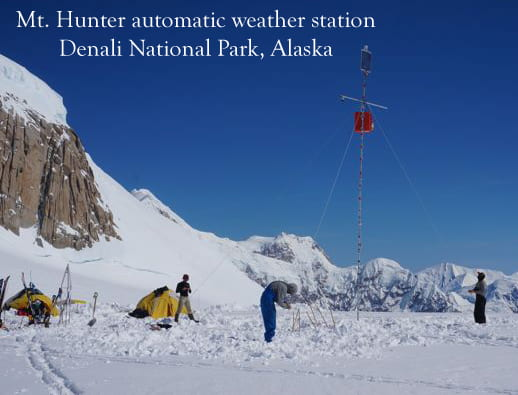
Mt. Hunter automatic weather station · Denali National Park, Alaska
The same physics that govern how snow changes over 10,000 years govern how it changes over two hours.
WaxOracle’s wax prediction engine is grounded in physical principles from snow and ice science research. Dr. Erich Osterberg is Professor of Earth Sciences at Dartmouth College and one of the world’s leading experts in ice, snow, and climate science — his specialty is analyzing the chemistry and physical properties of snow and ice to understand how they change over time and in response to atmospheric conditions.
His research spans ice cores from mountain glaciers and ice sheets across Alaska, Greenland, and Antarctica, giving him a uniquely deep understanding of how snow temperature, crystal structure, humidity, solar radiation, and atmospheric chemistry interact at the surface level — the exact conditions that determine how a ski glides.
Dr. Osterberg holds a B.A. from Middlebury College, an M.S. from the University of Otago, and a Ph.D. from the University of Maine. He has published dozens of peer-reviewed papers in journals including Nature Geoscience, Geophysical Research Letters, and the Journal of Glaciology.
The snow surface energy model at the core of WaxOracle — combining solar radiation, longwave exchange, latent heat, sensible heat, and deep snow temperature evolution — is grounded in the same physical principles researchers apply to understand how snow changes across decades and centuries. WaxOracle applies that science to a two-hour race window.
Already have an account? Log in